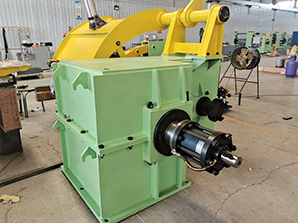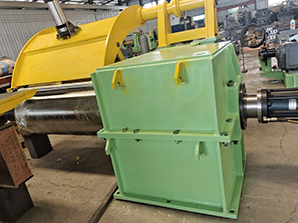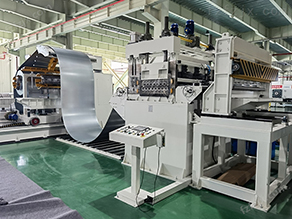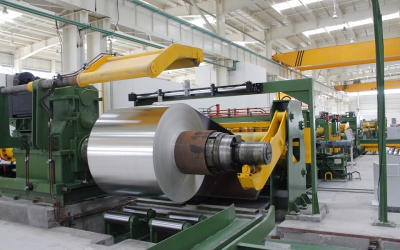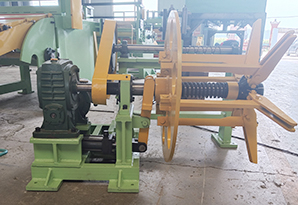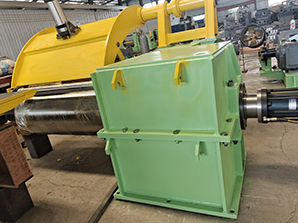
rewinding machine
Here is an English translation of your Chinese text:
Key Points
Steel coil processing requires very high tension, rigidity, and centering accuracy; rewind machine components must offer high load-bearing capacity, low deformation, and long-term stable operation.
Strong corrosion resistance, easy maintenance, fast roll changes, and high safety are key competitive advantages in steel coil scenarios.
Key Components and Advantages (by component category)
Tension and Winding Control Unit
Advantage: closed-loop tension control with fast response in torque/speed adjustment, ensuring uniform tension on heavy steel coils during winding, with wrinkle-free and uniformly wound diameters.
Why it matters: steel is hard and has strict surface finish requirements; stable tension significantly reduces edge defects and reel-core eccentricity.
Take-up Drive and Clamping System (Drum/Collet)
Advantage: high-torque servo drive or hydraulic/pneumatic actuation, suitable self-locking gripping, quick take-up drum replacement and positioning, compatible with different coil diameters and weights.
Why it matters: steel coils arey; secure grip and precise alignment directly affect winding quality and changeover efficiency.
Edge Guide and Centering System
Advantage: high-rigidity edge-guiding mechanism, wear-resistant edge guide plates, and precise centering, maintaining edge straightness even under high tension.
Why it matters: prevents edge jumping and edge waviness during high-speed winding, improving finished-edge quality.
Take-up Drum and Roller Assembly (Main Drum, Pressing Rollers, Press Rings, etc.)
Advantage: customizable parameters for specific steels (hot-rolled/cold-rolled/galvanized/high-strength steel, etc.), coil diameter/weight range, and line speed; on-site tuning, remote diagnostics, quick spare parts, and localized service.
Why it matters: different steel grades and processes require different equipment parameters; customization can improve winding quality and line stability.
Specific Benefits for Steel Coil Processing Lines
Improve yield and winding quality: stable tension, precise centering, reliable edge guidance, and significant reductions in wrinkles, edge defects, and reel-core eccentricity.
Reduce downtime and changeover time: rapid roll changes, modular components, remote diagnostics, and predictive maintenance to shorten unplanned downtime.
Increase line throughput and overall energy efficiency: heavy-load design and optimized drive/control strategies to raise line speed and energy efficiency.
Lower maintenance costs and inventory pressure: standard components, easy-to-maintain structures, and faster spare-parts response to reduce maintenance costs.
If you’d like, I can tailor this further to specific steel grades, coil sizes, line speeds, or automation levels, and provide a customer-facing marketing version or technical spec sheet.
Product Overview
Scope: Used to rewind processed materials (such as steel coils, paper, film, metal foil, textiles, etc.) into rolls, meeting varying process requirements for tension, centering, and winding diameter control.
Core Value: High load-bearing capacity, low deformation, and long-term stable operation; strong corrosion resistance, easy maintenance, fast roll changes, and high safety. These features help improve finished product quality, reduce downtime, and lower maintenance costs.
Key Technical Parameters (general; customizable by model)
Maximum Roll Weight: in kg or t
Roll Diameter Range: minimum roll diameter – maximum roll diameter (mm)
Core Specifications: inner diameter / outer diameter / thickness range (mm)
Main Drum Diameter & Pressing Roller Configuration: diameter range, quantity, material
Drive Type: servo motor / stepper / hydraulic / pneumatic; whether hybrid drive is supported
Tension Control Method: closed-loop tension control, tension forecasting and correction
Edge Guide & Centering: edge guide rigidity, centering accuracy, centering tolerance
Sensing & Measurement: tension sensors, speed/position sensors, encoders, edge-guide displacement sensors
Control System: PLC / motion controller, HMI, fieldbus / Ethernet communications (e.g., Modbus TCP, PROFINET, EtherNet/IP, etc.)
Power Consumption & Noise: power requirements, standby power, operating noise level
Environment & Protection: operating temperature, humidity range, IP rating
Safety Standards: emergency stop, interlocks, guards, protective fences conforming to standards
Structure & Materials: main body material, coatings, anti-corrosion treatment, roller assembly materials
Maintenance & Lifespan: modular design, replacement intervals for key components, recommended maintenance intervals
Structural Design Points
Main Components: Tension control unit, take-up/rewind drive and clamping system, edge guide & centering system, main roll and pressing roller assembly, take-up drum/collet, clamping release and safety interlocks, control system and sensing network
Materials & Surface Treatments: high-strength steel or aluminum alloy structure, wear-resistant coatings, anti-corrosion coatings, sealing and lubrication design
Modular Layout: easy on-site debugging, quick replacement of components, secondary development and expansion
Automation & Intelligence
Control & Monitoring: PLC/HMI, data acquisition, real-time tension/speed/status display
Online Diagnostics & Maintenance: fault diagnosis, predictive maintenance, remote diagnosis and upgrades
Process Management: dispatch of process parameters, batch/process traceability, integration with upstream/downstream equipment
Remote Support: remote diagnosis, on-site training, rapid parts supply
Applications & Customization
Industries: steel coil processing lines, film production lines, paper winding, metal foil, textile materials, etc.
Customization Options: roll diameter/weight range, target line speed, automatic changeover strategies, inspection and online quality control, interface language and localization
Customer Pain Point Solutions: improve yield, shorten changeover time, reduce manual interventions, improve energy efficiency and line utilization
Installation, Commissioning & After-sales
Installation & Commissioning: on-site survey, equipment assembly, system integration, process debugging
Training & Documentation: operator training, maintenance training, complete technical manuals, fault diagnosis guides
Spare Parts & Maintenance Services: standard parts inventory, rapid local service, remote diagnostics, annual maintenance plans
Warranty & Upgrades: standard warranty period, upgrade options, upgrade paths and compatibility
7.Product Overview
Scope: Rewinds processed materials (e.g., steel coils, paper, film, metal foil, textiles, etc.) into rolls, with control over tension, alignment, and winding diameter to meet diverse process requirements.
Core Value: High load-bearing capacity, low deformation, and long-term stability; strong corrosion resistance, easy maintenance, fast roll changes, and high safety. These features boost finished-product quality, minimize downtime, and reduce maintenance costs.
8.Key Technical Parameters (general; customizable by model)
Tmax: maximum tension (kN or kips)
Tension Range: Tmin – Tmax (e.g., 0.5–10 kN)
Line Speed: up to X m/min (model-dependent)
Max Roll Weight: X kg or X t
Roll Diameter Range: from X mm to Y mm
Core Specifications: inner/outer diameter and thickness range (mm)
Main Drum Diameter & Pressing Roller Configuration: diameter range, quantity, material
Drive Type: servo, stepper, hydraulic, pneumatic (hybrid drive supported)
Tension Control: closed-loop tension control; tension forecasting and correction
Edge Guide & Centering: high-rigidity edge guides, wear-resistant guide plates, centering accuracy within specified tolerance
Sensing & Measurement: tension sensors, speed/position sensors, encoders, edge-guide displacement sensors
Control System: PLC / motion controller, HMI, fieldbus/Ethernet (Modbus TCP, PROFINET, EtherNet/IP, etc.)
Power & Noise: power requirements, standby power, operating noise
Environment & Protection: operating temperature, humidity range, IP rating
Safety: emergency stop, interlocks, guards, protective fencing
Structure & Materials: main body material, coatings, anti-corrosion treatment, roller materials
Maintenance & Lifespan: modular design, replacement intervals for key components, recommended maintenance intervals
If you’d like, I can:
tailor a formal product detail page text by model for website, product manuals, or quotes
provide a polished English version of more complete marketing copy or a technical whitepaper outline
generate two parameter sheets and comparison copy for different market positioning based on target industries and ranges. Tell me your target industry, specific models or parameter ranges, and whether you need an English version.