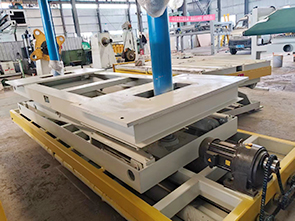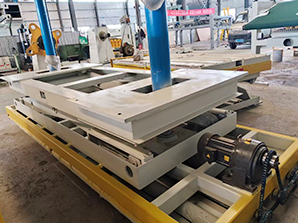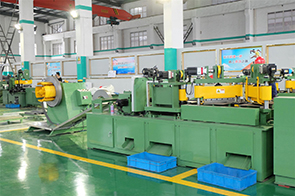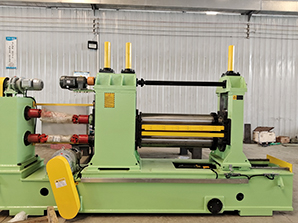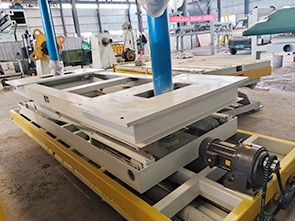
Metal plate processing line – Lift table components
Metal plate processing line – Lift table components: Functions and Advantages
Loading/unloading and height switching
Enables smooth lifting between different station heights to complete loading, unloading, or station-to-station transfer.Buffering and positioning during conveyance
Acts as a support and connecting interface between roller conveyors/conveying lines and downstream equipment (e.g., punching, bending, leveling, feeding, bending dies), ensuring plates enter the next process smoothly.Height alignment for process consistency
Height-controlled lifting allows accurate matching with fixtures and positioning devices, reducing manual adjustments and improving consistency.Reduces manual handling and labor intensity
Allows plates to be transferred and circulated within the conveying and lifting modules, reducing manual lifting,, and repetitive operations.Strong process adaptability
Can be configured according to plate thickness, dimensions, and height requirements of different stations, improving line compatibility and efficiency.High positioning accuracy and more stable mating
Provides stable height control and good repeat positioning performance, reducing the risk of misalignment, rework, and scrap.Smooth operation to minimize scratches and deformation
Structural and control design ensure smooth lifting/lowering, reducing sliding, knocking, scratching, and force-induced deformation during loading/unloading.Improves cycle time and overall efficiency
When integrated and synchronized with the conveying line, it shortens plate waiting and adjustment time between stations, boosting overall line output.Safe and reliable
Typically includes safety features such as limit switches, anti-misoperation protection, and overload protection to reduce risk to equipment and personnel.Lower maintenance cost and easier operation
Facilitates automation integration—integrates with feeders, roller conveyors, fixtures, robots, and loading/unloading stations—supporting line upgrades and retrofits.
Product Overview
Lift table components are used in horizontal shear lines for material loading/unloading and to match the workpiece height between stations. By enabling stable lifting, precise height positioning, and smooth transfer/mating, they help metal plates/strips move between different stations reliably. This improves the continuity of the horizontal shear process and enhances the consistency of the finished products.
Main Functions
Loading/unloading lifting & height switching:
Ensures the plate/strip height is correctly matched between the loading end, the shearing station, and the unloading end.Support and buffering positioning:
Provides stable support between roller conveyors/conveying sections and the shear machine, ensuring proper material arrival and reducing vibration, shifting, and misalignment.Alignment and process consistency:
Works with height control and positioning devices to make material entry into the shearing station more stable, reducing shear quality issues caused by height deviations.Reduces manual handling and stops for adjustments:
Minimizes repetitive lifting, waiting, and manual leveling, improving the overall cycle time of the shear line.
Structural & Functional Features
Reinforced load-bearing structure:
Designed to meet the load requirements of horizontal shear line operations and long-term continuous running.Guided lifting mechanism:
Ensures smooth lifting motion and improves repeat positioning accuracy.Worktop contact protection:
Anti-scratch / anti-slip / wear-resistant tabletop design reduces the risk of surface scratching and slipping of plates/strips.Safety and protection configurations:
Includes travel limiters, anti-misoperation functions, overload protection, emergency-stop interlocks, etc., to meet production line safety requirements.Integration-friendly for line interlocking:
Can be synchronized with roller conveyors, feeding/receiving mechanisms, and the shear main unit.
Applicable Scope
Loading, receiving, buffering, and transfer/mating stations in a horizontal shear line
Metal plate/strip processing sections that require height adjustment and stable load support
Retrofit or new-line integration with roller conveyors, conveying lines, robots, and automatic loading/unloading systems
Customization Service
According to your horizontal shear line requirements—such as material specifications (width/thickness), shearing station height, feeding method, and cycle time requirements—we can customize the lift table’s table size, lift stroke, load capacity, and control/interlock solution.