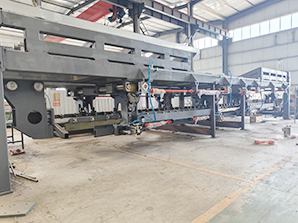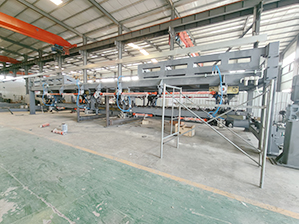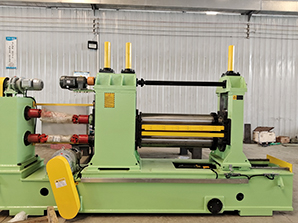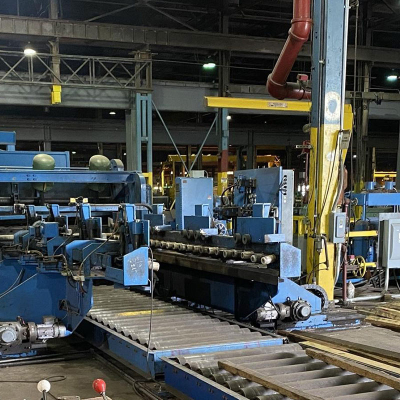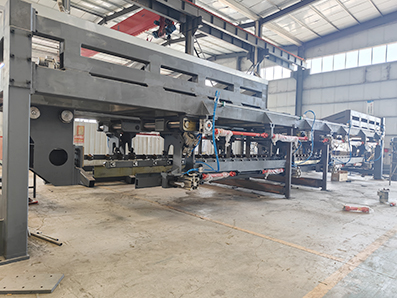
Palletizing machine
Adapts to the line takt/cycle time and ensures stable synchronization
Synchronizes with the upstream cross-cutting line via master/slave control to minimize waiting time.
Implements buffer strategies to prevent production loss caused by line stoppage/accumulation.
High positioning accuracy for neat palletizing and excellent layering
Ensures consistency between layers through centering, landing-point correction, and height control.
Reduces tipping, misalignment, and damage, improving stability for downstream packing and transportation.
Configurable palletizing patterns
Supports configurable stacking rules.
Handles different product sizes and weight ranges (within the selected configuration).
Strong durability and reliability
Uses reliable solutions for key transmission and actuating components.
Optimized structure reduces impact and wear, extending maintenance intervals.
Comprehensive safety features
Provides guarded protection for motion areas and performs fault self-checks to reduce risks to personnel and equipment.
Easy maintenance and fast commissioning
Modular design makes part replacement and cleaning more convenient.
Standardized electrical interfaces and parameter setup procedures shorten on-site commissioning time.
User-friendly HMI with fast fault diagnosis
Visual HMI with clear status display and alarm information.
Helps operators quickly identify issues and improve recovery time after stoppages.
Optional peripheral functions to enhance line value
Automatic pallet changing.
Integration with stretch wrapping/strapping (packing) systems.
The metal coil palletizing machine is used to automatically stack metal materials from upstream processes:
At the front end, it performs palletized loading/support for the whole coil to facilitate handling and turnover.
At the rear end, it stably positions the metal sheets/strips obtained from cross-cutting and stacks them into layers, then automatically outputs them to downstream packaging/transfer stations.
The equipment synchronizes and operates with the production line to meet high efficiency, heavy-duty handling requirements, and safe/stable operation.
1. Two-stage process integration: whole-coil palletizing + sheet/strip layered palletizing
Whole-coil palletizing section: Adopts stable bearing support and anti-slip positioning to ensure the heavy coil remains stable during loading, reducing vibration and collision risks.
Cross-cut sheet/strip section: According to the characteristics of the cut sheets/strips, it uses centering positioning and landing-point control to achieve consistent stacking between layers.
The overall design is optimized for the “heavy coil + layered stacking of cut sheets” dual working conditions.
2. Takt matching and stable interlocking
Supports synchronization with upstream cutting/cross-cut lines (master-slave control) to reduce waiting time and prevent line stoppages.
Implements a reasonable buffering strategy and action-sequence logic to absorb output fluctuations from the cross-cutting line, ensuring continuous and stable palletizing motion.
After stacking is completed, it quickly releases the pallet to keep downstream packaging/warehousing processes running smoothly.
3. Precise positioning for neat stacking (excellent layer forming)
Centering/landing correction: Improves landing consistency through pallet positioning, guides, and position “at-destination” detection.
Height control: Accurately controls the stacking height layer by layer according to layer height and palletizing rules, reducing misalignment between layers.
Anti-tipping / anti-tilting / anti-scratching: Reduces tipping during transport and edge damage risks, improving packaging stability.
4. Configurable palletizing patterns to handle multi-spec production
Supports palletizing parameter customization for different sheet/strip sizes and weight ranges (number of layers, layer height, placement direction, stacking gap, etc., based on configuration).
Supports different pallet specifications and stacking height settings; quick parameter adjustment for changeovers, improving production flexibility.
Can realize sequential or interleaved stacking strategies (per customer requirement).
5. Comprehensive safety configuration
Equipped with protective zones, interlocks, and emergency stop protection (depending on configuration).
At-position detection and fault self-check: Automatically alarms and prevents hazardous actions in abnormal conditions.
Ensures operator safety and stable equipment operation, reducing accident risk.
6. Visual control and fast fault diagnosis
HMI (touchscreen) displays operating status, action steps, and alarm information.
Provides visualized fault causes for operators to quickly troubleshoot and restore production.
Supports production statistics and running records.