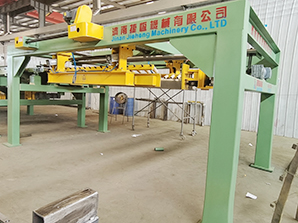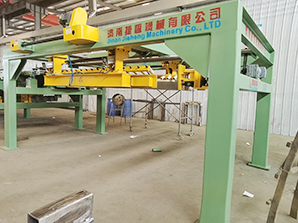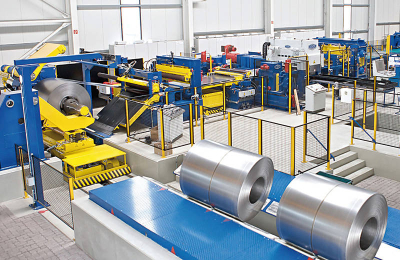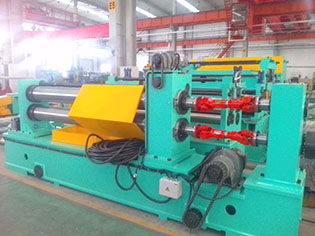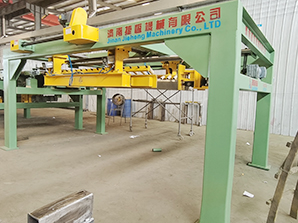
palletizing line
This palletizing machine is designed for post-processing of metal coils, featuring a high-capacity gripping unit, reinforced edge protection and anti-corrosion construction, and precise timing synchronization with the swing shear line to ensure efficient and stable stacking and shipment.
To accommodate varying metal parts with different thicknesses and sizes, the system offers quick changeovers, adjustable layer height, and expandable safety protection to boost on-site safety and productivity.
Seamless integration with MES/ERP provides real-time status, throughput and maintenance data for production planning and quality traceability.
The palletizing machine for metal sheet processing can boost production line capacity and stability.
It enables continuous operation, significantly increasing palletizing throughput per unit time and reducing downtime caused by operator fatigue.
Lower labor costs and physical workload
Delegating handling and stacking to the equipment leads to substantial long-term operating cost savings and reduced on-site labor intensity.
Improve palletizing quality and consistency
Stable layer alignment and neatly stacked pallets reduce damage to workpieces, slipping, and layer misalignment, improving finished product quality.
Strengthen workplace safety
Replacing high-intensity manual handling lowers the risk of worker injuries and helps meet safety production requirements.
Rapid line changes and flexible adaptation
Supports multi-product, small-batch production with quick changeovers and adjustable pallet/layer heights, boosting production flexibility.
Product Positioning & Applications
Palletizing components for the downstream stage of metal steel coil processing lines, designed for high-load handling, stable sheet alignment, and easy maintenance. Supports rapid changeovers for multi-product, small-batch production with high stacking efficiency, and can synchronize timing with swing shear lines and other downstream processing equipment.
Key Components & Functions (with bilingual labels)
Material Feeding & Input Zone
Function: Feeds pallets or coil parts, centers/aligns, and performs initial leveling to ensure stable downstream picking and stacking.
Gripping & Placement Unit
Function: Grips and places steel coils from the conveyor using mechanical grabs, clamps, or vacuum, with high-load capability and surface-protection design.
Layer Alignment & Preparation
Function: Aligns and flattens each layer, applies anti-slip measures to ensure uniform layer height and stable stacking.
Conveying & Synchronization System
Function: Transfers parts between stations with smooth motion and beat synchronization, handling high-load impacts.
Positioning & Sensing System
Function: Achieves precise positioning, counting, load monitoring, and anomaly detection via sensors and vision systems.
Control System & HMI
Function: PLC/servo drives control, parameter setup, live monitoring and fault diagnosis with an intuitive HMI.
Safety & Maintenance System
Function: Safety enclosures, emergency stops, light curtains, interlocks; ensures operator safety and easy maintenance/parts replacement.
Post-processing & Auxiliary Units
English: Function: Final packaging steps (strapping, sealing, labeling, weighing) post-palletizing.
Data Interfaces & System Integration
English: Function: Seamless data exchange with MES/ERP, real-time monitoring and diagnostics for traceability and planning.
Swing Shear Line Coordination Points (Key Timing & Interface)
Timing & Cadence Alignment
Must precisely align with the swing shear line’s output cadence to avoid conflicts between stacking height and cutting actions.
Robot Arm / Swing Shear Line Coordination
Pickup/placement timing must synchronize with the shear line cadence to ensure line continuity.
Torque & Impact Control
Swing shear lines may generate impact and vibration; the palletizer should have buffering, damping, and torque control to prevent deformation or surface damage.
Safety Interlocks & Fault Tolerance
Establish a unified safety strategy across devices with interlocks to ensure safety when not in operation.
Quality & Traceability Points
Set up quality inspection points at interfaces, linked to downstream checks from the swing shear line to ensure all items entering palletizing meet requirements.
Technical Parameter Examples (adjustable per configuration)
Load & Layer Height
Load per layer: customized based on steel coil thickness and weight; typical range 50–2000+ kg per layer; exceptionally large parts customizable
Maximum pallet size: 800×600 mm to 1200×1200 mm (expandable)
Layer height adjustable range: 100–1200 mm
Materials & Construction
Materials: stainless steel 304/316, carbon steel; anti-slip / anti-scratch coatings on key contact surfaces
Drive & Controls
Drive: servo-based (some sub-systems may use stepper); Control: PLC/embedded controller + HMI
Environment & Certifications
Protection class: IP54/IP65 (depends on installation environment); complies with IEC/UL standards
Interfaces & Integration
Supports OPC UA, MTConnect, industrial Ethernet, etc., for easy integration with the swing shear line control system and higher-level systems
Key parameters should be determined in consultation with swing shear line specs, feeder system, coil dimensions, weights, and stacking strategy. Options include high-strength gripping mechanisms, vision positioning, weight sensing, online inspection, quick-change pallets, different layer-height templates, dedicated swing shear timing coordination module, and MES/ERP integration.
Project Kick-off and After-Sales Service
It is recommended to conduct on-site process evaluation at project outset to confirm maximum coil weight, thickness, pallet size, and safety clearances. Deliverables include mechanical frame, drive and control modules, HMI, basic safety accessories, initial commissioning and training. Optional services include on-site installation, debugging, specialized training, remote diagnostics, spare parts kits, and maintenance plans.