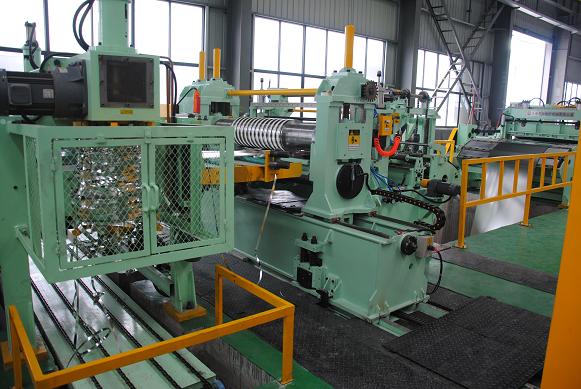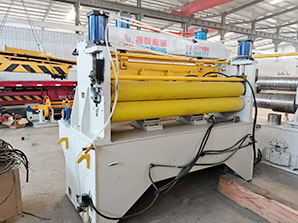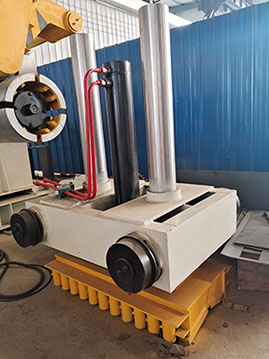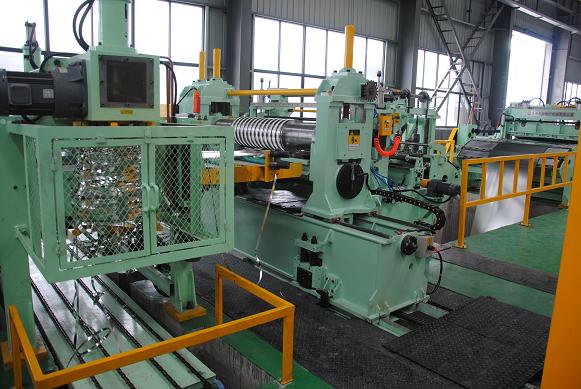
Longitudinal Slitting-Rewinding Line
High Slitting Precision
With a longitudinal positioning and web guiding control scheme, the cut line is neat and the slitting deviation is small, making it ideal for production with strict requirements on dimensional consistency.Stable Rewinding Tension
The tension control system achieves constant-tension rewinding, preventing roll defects such as loose winding, over-tight winding, edge curling, or wrinkling.High Efficiency & Flexible Changeover
Compact structure and well-coordinated mechanisms provide fast production cycle time. Adjustments for different specifications (slit width/roll diameter) are quick, reducing downtime.Wide Material Compatibility
Suitable for slitting and rewinding various roll materials, such as metal sheets/steel coils, metal foils, composite materials, and insulating materials (depending on the configuration of your machine).Beautiful Finished Roll Appearance
Optimized dancer rollers/guide rollers and rewinding mechanisms ensure a flat web surface and tidy layer stacking, meeting requirements for downstream slitting, lamination, packaging, and other processes.Safety & Reliable Design
Proper protection for key components, stable electrical and transmission systems, and safety features such as overload protection and E-stop interlocks.Highly Configurable Automation
Optional functions are available, such as automatic counting/length measurement, automatic edge alignment, automatic slitting/discharging, and rewinding control, reducing manual labor.Easy Maintenance & Service
A modular design for key parts allows faster daily inspection and quicker replacement of consumables, lowering maintenance downtime and cost.Stable and Repeatable Production
Using process parameter memory and closed-loop control, the line can deliver consistent product quality across multiple batches.
Longitudinal Slitting & Rewinding Machine — Product Details
1) Equipment Purpose
The longitudinal slitting & rewinding machine is used to slit the parent roll material longitudinally (longitudinal slitting). By means of automatic rewinding/roll forming, it delivers continuous output of multiple finished rolls. It is widely used for slitting processing of roll materials such as metal sheets, steel coils, metal foils, composite materials, insulating materials, and films.
2) Main System Components
Unwinding System: Constant-tension unwinding to ensure stable feeding and prevent material looseness or stretching deformation.
Web Guiding & Tension Control Module: Closed-loop tension control to stabilize the feeding tension.
Longitudinal Cutting Unit: Longitudinal positioning/guiding mechanism together with cutting blades to achieve precise slitting.
Rewinding Drive & Roll Forming Mechanism: Multi-channel rewinding or rewinding corresponding to each slit strip, producing neat roll shapes.
Finished Counting / Length Metering / Edge Alignment Unit (Optional): Improves finished consistency and operating efficiency.
Electrical Control System (PLC / Touchscreen): Parameter setting, running monitoring, and interlock protection.
Safety Protection System: Emergency stop, overload protection, door access / safety guard interlocks, etc.
3) Key Technical Features
High-precision Slitting Control
Uses longitudinal positioning and guiding control; the cut lines are clean and the slitting deviation is small.Constant-Tension Rewinding
Tension control ensures stable rewinding, preventing loose winding, over-tight winding, edge curling, or wrinkling.Stable Roll Shape & Neat Layer Stacking
Optimized rewinding roller arrangement and tension/dancer roller layout to keep the roll surface flat and layers tight and orderly.Fast Changeover for Different Specifications
Easy adjustment for slit width and roll diameter changes, reducing downtime and setup time.Configurable Automation Functions (Optional)
Supports automatic counting, length measurement, automatic edge alignment, and automatic web cutting/discharge or rewinding control to reduce manual workload.
4) Applicable Materials (Examples)
Metal rolls: steel coils, metal sheets, metal foils
Non-metal rolls: composite materials, insulating materials, films, etc.
Actual applicability depends on the machine’s blade configuration and the material width/thickness range.
5) Operating & Control Modes
PLC + Touchscreen: Parameter input, process storage, fault alarms
Operating Modes: Manual/Automatic switching available
Interlock Protection: Emergency stop, overload protection, monitoring of key sensors
Production Data Logging (Optional): length metering, counting, batch information, etc.
6) Finished Product Performance
Good consistency in slitting width
Attractive roll appearance with neat layer arrangement
Meets downstream processes such as slitting packaging, lamination/laminating, packaging, coating, and further rewinding requirements
7) Optional Configurations
Automatic edge alignment / correction system
Multi-station rewinding
Automatic length switching and automatic discharge
Auxiliary web suction/correction and edge detection
Blade types and materials adapted to different requirements