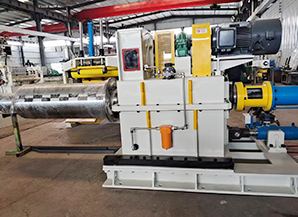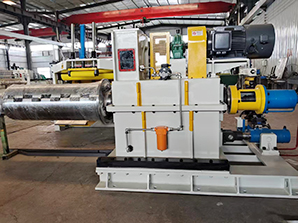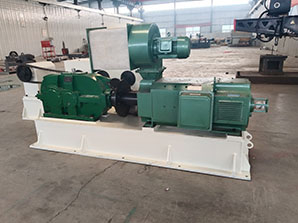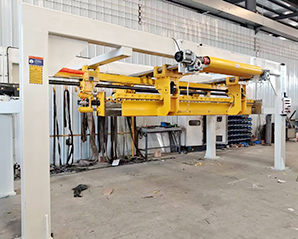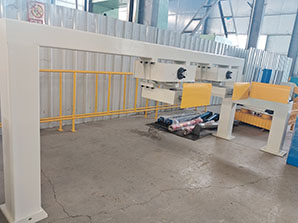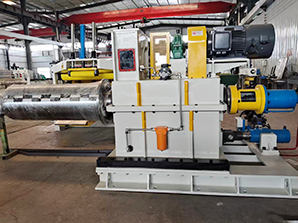
uncoiling machine
Precise tension control for consistent unwinding.
High-speed, smooth material feeding to reduce downtime.
Wide compatibility with coil sizes, widths, thicknesses, and materials.
Automated operation with servo drive, tension sensing, and remote diagnostics.
Enhanced safety features including emergency stop and overload protection.
Seamless integration with downstream equipment for higher line throughput.
Reduced manual handling and operator fatigue through automation.
Robust, modular design with low maintenance requirements.
Energy-efficient servo-driven operation.
Quick changeover and flexible line adaptation.
Compact footprint suitable for retrofit and space-constrained installations.
Data-driven monitoring and remote support for predictive maintenance.
Product Overview
Function: Unwinding at the front end of the strip processing line to achieve stable unwinding, high-precision tension control, and smooth feeding, with seamless integration to downstream equipment (e.g., cutting, coating, straightening, etc.).
Applicable Materials: Steel, aluminum, and other metal strips, widely used in automotive, home appliances, packaging, and furnishings.
Basic Structure: Reels/unwinding drum, tension sensing with closed-loop control, clamping/unwinding mechanisms, drive unit, protective cover and safety interlocks, control cabinet and HMI.
Applicable Range
Coil diameter range (inner/outer options): commonly Ø450–Ø1500 mm (model-dependent)
Coil width: about 80–2000 mm (depends on model)
Thickness range: about 0.2–6.0 mm
Maximum tension and line speed: varies by model; typical range 0–tens of kN for tension and up to about 150 m/min for line speed
Material compatibility: steels, magnesium alloys, aluminum and other metals
Key Features and Benefits
Stable tension closed-loop control: ensures flat, uniform tension during unwinding and reduces coil deformation
High-speed, smooth feeding: increases line speed and reduces downtime caused by feeding instability
Wide applicability: supports a range of coil diameters, widths, thicknesses, and materials
Automation and intelligence: servo drive, tension sensing, data collection, remote diagnostics, predictive maintenance
Safety and user-friendliness: emergency stop, overload protection, anti-pinch features, and an easy-to-use HMI
Seamless integration with downstream processes: easy interfacing with cutting, coating, straightening, and other equipment to boost line throughput
Low maintenance, modular design: easy-to-replace consumables with standardized modules for expansion
Energy efficiency and cost benefits: servo-driven/inverter-driven design enhances efficiency and reduces long-term operating costs
Technical Parameters (example; actual models vary)
Inner diameter options: 508 mm, 610 mm, etc.
Coil diameter range: 450–1500 mm
Coil width range: 80–2000 mm
Thickness range: 0.2–6.0 mm
Max line speed: 0–120–150 m/min (depends on model)
Tension control: closed-loop servo tension control; tolerance typically ±1–3% (depends on sensors and control system)
Servo drive power: 7.5–75 kW (model-dependent)
Control system: PLC + HMI; optional industrial PC/SCADA interfaces
Protection and safety: emergency stop, overload protection, interlock door protection, anti-pinch devices
Structural Composition
Unwinder/reel and clamping mechanism: secure fixation and unwinding of the material
Tension sensing and control system: tension sensor, servo drive, closed-loop control unit
Drive and drive unit: servo motor or AC variable-frequency drive, matched to speed and tension requirements
Frame and support structure: sturdy chassis, guides, center-alignment mechanism
Safety protection and HMI: protective cover, interlocks, touch-screen HMI, emergency stop button
Control cabinet and electrical system: fuses/disconnects, terminal blocks, cable management, grounding
Control System and Software
Basic control: PLC + touch HMI
Motion control: servo drive implementing closed-loop tension and unwinding speed
Data and diagnostics: tension curve recording, equipment status monitoring, fault self-diagnosis, remote diagnostics option
Optional extensions: interfaces with upstream/downstream equipment (SCADA, MES, cloud diagnostics), predictive maintenance algorithms
Standard Configuration vs Optional Configuration
Standard: unwinder drum, tension sensing + closed-loop control, servo drive, pneumatic/hydraulic clamping, protective cover, emergency stop and interlocks, control cabinet, HMI, basic cables and mounting hardware
Optional: larger/smaller inner-diameter options; customization of coil width/thickness ranges; automatic feed correction; online coating interface; offline/online quality inspection equipment; remote maintenance services; cloud data analysis
Safety and Certification: CE, ISO 9001 compliance and labeling
Installation and Commissioning
Installation site requirements: level floor, adequate space, compliant with safety protections
Commissioning: mechanical alignment, tension parameter calibration, system self-test, interface with downstream equipment
Acceptance and Training: provide factory test reports, on-site training to ensure operators can operate independently
Maintenance and Servicing
Routine maintenance: mechanical lubrication, tension sensor calibration, interlocks and safety system checks
Wear parts: replacement cycles depend on usage; provide wear-part lists and replacement procedures
Spare parts and service: OEM spare parts, remote/onsite service options during the warranty period
Quality and After-Sales
Quality checks: factory-wide tests (tension, speed, alignment, emergency stop, etc.)
Warranty and support: standard warranty period; on-site service, remote support, upgrade options by region
Technical Support: product literature, operation manuals, installation and commissioning videos, technical consultation
Common Application Scenarios
Unwinding of thin metal sheets for automotive manufacturing and parts processing
Front-end processing lines for appliance housings, metal packaging materials
Front-end unwinding for downstream processes such as metal coating, straightening, punching
Quotation and Customization
Please provide: material type to be processed, coil width/thickness range, target line speed, coil diameter range, required safety and control level, region
We will provide specific models, parameters, lead times, and quotations based on this information