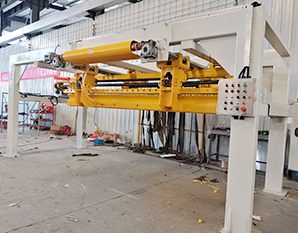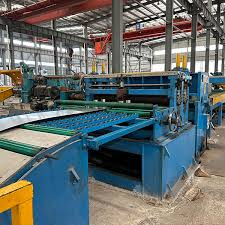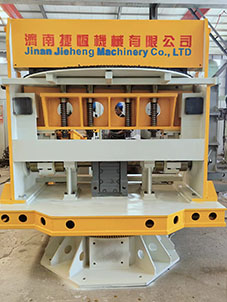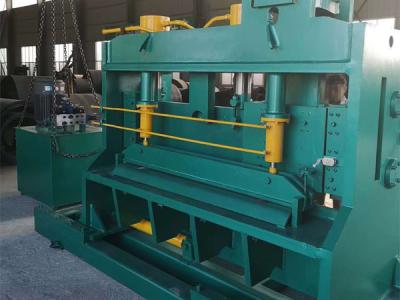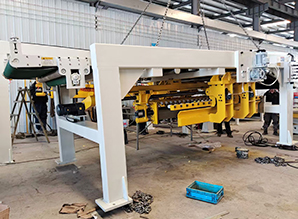
palletizing robot
Heavy-load capacity and stability
One-pass placement and multi-layer stacking to accommodate varying steel thickness and heavy weights; rigid structure and high stacking stability.
Steel surface protection and quality maintenance
Design features such as soft pads, rubber clamps, and anti-scratch coatings to reduce contact damage and preserve surface integrity and appearance of sheets/plates/coils.
High-precision alignment and uniform layer height
Precise alignment with controllable interlayer height; reduces misalignment, rework, and defect rate.
Strong adaptability and fast line change
Supports multiple pallet sizes and varying thicknesses and widths of steel plates/coils; rapid line change suitable for small-batch, multi-SKU production.
Seamless integration with upstream/downstream systems
Easy interfacing with packaging lines, conveyors, barcode/RFID, WMS/ERP/MES to achieve end-to-end digital information flow.
Steel-material-specific design
Reliable gripping and stable stacking under surface oil, oxidation, and post-heat-treatment characteristics; uses temperature-resistant and oil-contaminant-resistant materials and components.
Safety and regulatory compliance
Enhanced finger protection, safety light curtains, emergency stop, interlocks; meets safety requirements for high-intensity production environments.
Diagnostics, maintenance, and availability
On-board self-diagnostics, remote monitoring, and predictive maintenance guidance to reduce failure rates and unplanned downtime.
Energy consumption and operating cost optimization
Efficient drive and motion control strategies to reduce energy use; modular design lowers maintenance and spare-parts costs.
Reliability and maintenance friendliness
Modular construction and extensive use of standard parts; easy on-site maintenance, stable spare-parts supply, short downtime.
Environmentally friendly and easy to clean
Dust-proof, easy to clean, and corrosion-resistant material choices to meet cleanliness requirements of metal-processing workshops.
Customization and after-sales service
Can tailor grabbing mechanisms, fixtures, and conveying solutions to line layout and site conditions; localized service, training, and rapid spare-parts response.
Overview
Product positioning: For automatic palletizing, full-pallet formation, sorting, and pre-storage preparation of metal coils and steel plates on processing lines, aimed at improving line throughput, stability, and safety.
Target customer scenarios: Hot rolling, cold rolling, galvanizing, cutting/rolling, post-coating feeding, stamping after stacking, etc.; supports small-batch, multi-SKU production.
Applicable materials and scenarios
Applicable material types: Steel coils and steel plates (covering varying thicknesses, widths, and weights); surfaces may have oil, oxidation, heat-treatment marks, etc.
Example ranges: Thickness range [X–Y] mm, width range [A–B] mm, unit weight/stack weight limit [W kg], pallet sizes/specifications available.
Core selling points
Heavy-load capacity and stability: One-pass placement and multi-layer stacking; rigid structure and high stacking stability.
Steel surface protection and quality maintenance: Soft pads, rubber clamps, anti-scratch coatings to minimize contact damage and preserve surface integrity.
High-precision alignment and uniform layer height: Precise alignment with controllable interlayer height; reduces misalignment, rework, and defect rates.
Strong adaptability and fast line change: Supports multiple pallet sizes, thicknesses, and widths; rapid line changeovers; suitable for small-batch, multi-SKU production.
Seamless integration with upstream/downstream systems: Easy interfacing with packaging lines, conveyors, barcode/RFID, WMS/ERP/MES to enable end-to-end digital information flow.
Steel-material-specific design: Materials and components resistant to oil, temperature, and corrosion; reliable gripping and stable stacking.
Safety and compliance: Comprehensive protection, emergency stop, interlocks, etc.; suitable for high-intensity production environments.
Diagnostics, maintenance and availability: Self-diagnostics, remote monitoring, predictive maintenance guidance; reduces failures and downtime.
Energy consumption and operating cost optimization: Efficient drive and control strategies; modular design lowers maintenance and spare-parts costs.
Key technical parameters (template; customizable for actual models)
Rated load/unit weight limit: X–Y kg
Maximum stack height: Z layers (expandable)
Applicable thickness range: T_min–T_max mm
Applicable width range: W_min–W_max mm
Pallet sizes: Supported pallet specifications (e.g., 1000×1200 mm, 1100×1100 mm, etc.)
Cycle/capacity: Palletizing/sorting per hour (approx. under standard conditions; adjustable)
Gripping and fixture types: Vacuum suction cups, mechanical clamps, soft gripping, etc. (optional)
Control system: PLC/Industrial PC, HMI, standard communication protocols (Ethernet/IP/Profinet/Modbus, etc.)
Drive and actuation: Servo motors/Direct drive, servo amplifiers, timing belt/guide rails
Sensing and recognition: Encoders/optical sensors, lasers/vision, barcode/RFID recognition
Power and environment: Supply voltage/frequency, air requirements, operating temperature, humidity, IP rating
Dimensions and weight: Equipment weight, footprint, external dimensions
Safety design: Protective guarding, emergency stop, interlocks, light curtains
Environment and cleaning: Surface finish, dustproof, corrosion-resistant design Note: The above parameters are customizable ranges; refer to the actual model.
Structure and key components
Gripping unit: Combinations of vacuum cups, rubber clamps, and mechanical gripping; optimized for steel coil/sheet surface properties.
Palletizing and stacking unit: Multi-layer stacking mechanism, adjustable layer height, and alignment mechanisms.
Conveying and sorting system: Upstream/downstream conveyors, sorting guides, alignment devices.
Control and detection: PLC/HMI, SCADA/upper-system communication, sensor array, status self-diagnosis.
Safety module: Protective doors/shields, emergency stop button, light curtains/proximity switches, interlocks.
Automation and informatization
Seamless integration with packaging lines, material handling equipment, barcode/RFID, WMS, ERP, MES.
Data collection and traceability: Production data, equipment status, energy consumption, line throughput, fault diagnosis.
Remote monitoring and predictive maintenance: On-board self-diagnosis, remote diagnostics, maintenance recommendations.
Safety and compliance
Meets industry safety standards (e.g., CE/UL; region-specific). Optional finger protection, emergency stops, interlocks, light curtains.
Running costs and maintenance
Energy optimization: Efficient drive and motion control strategies.
Maintenance ease: Modular design, standard spare parts readily available, ample spare parts supply, quick spare-part response.
On-site maintenance and training: Simplified maintenance processes, on-site training and technical support.
Customization and services
Custom grabbing mechanisms, fixtures, and conveying solutions based on line layout, site conditions, and production goals.
Localized service, training, rapid spare-parts response, periodic maintenance programs.
Delivery and after-sales
Delivery contents: Main equipment, control system, software licenses, initial programs, installation and commissioning, training, spare-parts kit.
After-sales service: Warranty, on-site/remote support, upgrade and expansion options, spare-parts service levels.